







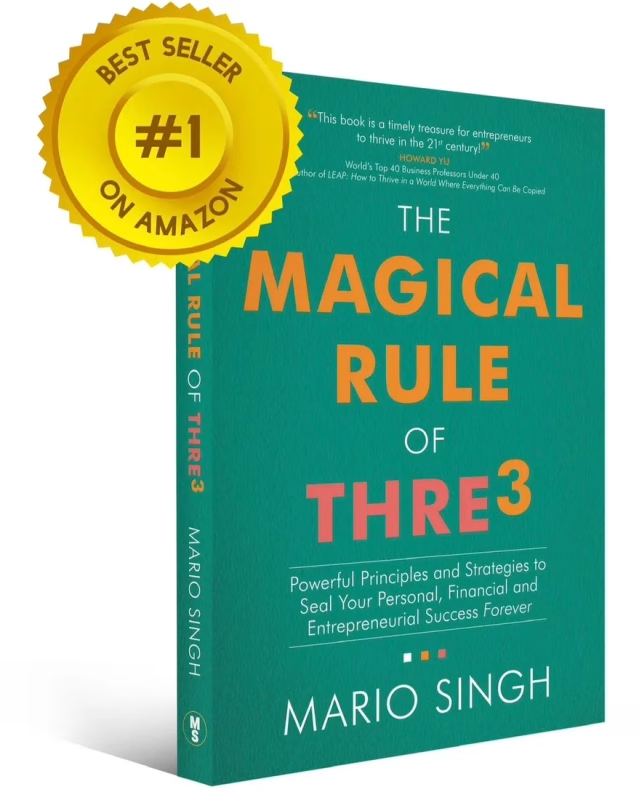
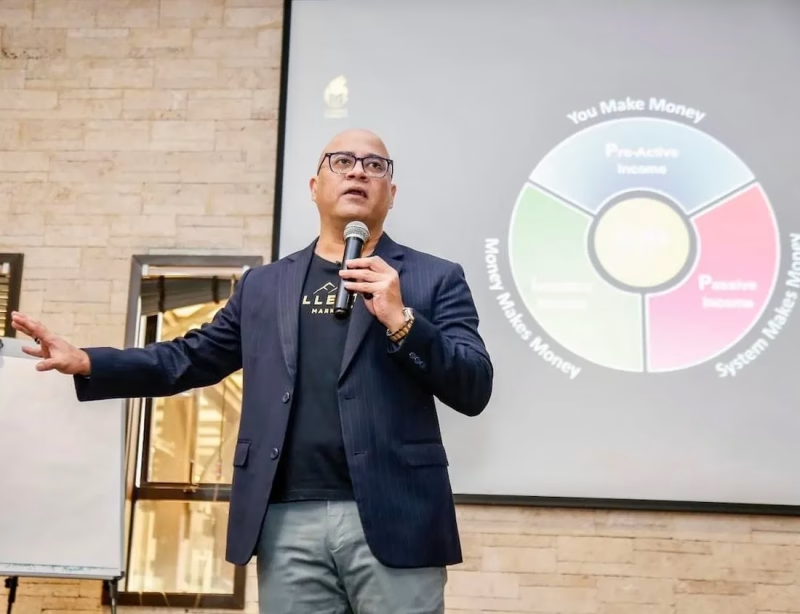
Meet Mario, the founder and managing partner of Masha Ventures, a dynamic venture company with a diverse portfolio spanning fintech, AI, health & wellness, education, and digital marketing. From humble beginnings as the founder of a small cleaning business after graduating with third-class honours in Chemical Engineering, Mario has transformed his entrepreneurial journey into a powerful force for innovation and impact. His leadership philosophy blends wisdom, courage, and compassion, and his ventures are built around the belief that business should be a platform for positive change. In this interview, Mario shares the insights, challenges, and forward-thinking strategies that continue to shape his work and the companies he mentors.

Q1: Can you describe your entrepreneurial journey and the motivation behind starting your business?
A1: My story began in 2001 when I graduated almost at the bottom of the barrel in university with 3rd class honours in Chemical Engineering. I couldn’t really find a job so I started a small cleaning company called Spick n’ Span.
All this time though, I was fascinated with the world of finance only because I had simplistic dreams of wanting to earn lots of money. My turning point came when I plucked up the courage to ask several mentors to tutor me in business and finance – and they agreed. This taught me my first real lesson in life – if you ask and don’t get what you want, you’re no worse off than you were before. However, if you ask and do get what you want, things change for the better. You can never lose by asking.
Today, I run a venture company called Masha Ventures which has a portfolio of companies in sectors like fintech, digital marketing, AI, big data, health & wellness and education.
The motivation behind starting my business is simple – you’re not only in the driver’s seat of positive change, but you get to impact and influence thousands of lives in the process. The tagline of the book “Trailblazer” by billionaire founder, chairman and CEO of Salesforce Marc Benioff says it best: The Power of Business as the Greatest Platform for Change. I believe that wholeheartedly. Every business should be a force for good.
Q2: How do you stay ahead of technological advancements in your industry, and how has this impacted your business model?
A2: I remember attending a masterclass recently by Mr Lim Siong Guan, the former Group President of Singapore’s sovereign wealth fund GIC. He mentioned something that stuck with me. He said that all of leadership can be categorised under 3 pillars:
- People
- A Spirit of Excellence
- The Future
He went on to say that most good leaders prioritise people and understand a spirit of excellence which are important. But many fail to anticipate the future which causes many problems down the road for themselves and the companies they lead. So putting an ear to the ground, networking with industry peers, reading up on innovation and understanding the scale of global technological advancement are all important tasks for me.
Former Canadian ice hockey great Wayne Gretzky said, “I don’t go to where the puck is. I go to where the puck may be.” It’s so true and so vitally important for every leader to anticipate the future and plan ahead.
As I run a venture company, I instil the same ethos and belief into all the CEOs of the companies in my portfolio. We must not only be ready to embrace change; we have to anticipate it and stay ahead of the curve. If we don’t, we run the risk of becoming the next Nokia, Blockbuster or Kodak.
Q3: What role does artificial intelligence play in your current operations or future plans?
A3: Definitely increasing by the day. No one can afford to ignore AI anymore. As an example, ChatGPT gets over 5 billion visits every single month.
The impact of AI goes beyond increasing productivity and lowering costs. It extends to having defensible intellectual property in my companies to stay ahead of the curve.
Here’s 3 examples of how we use artificial intelligence in our portfolio of companies:
- Development of market analytics for better trading and investing decisions in our fintech company.
- Development of AI agents for better workflow in our education company.
- Utilising free tools like Anthropic, ChatGPT and NotebookLM for press releases, striking pictures and insights for social engagement.
Q4: Can you share a significant challenge you’ve faced in your business and how you overcame it?
A4: For any entrepreneur who starts their journey, the thought of giving up happens constantly. The primary reason is because it’s just so hard. The entrepreneurial journey is simply not rational for someone who wants to change the world for the better. I have so many stories of my own about giving up: the time when I almost gave up writing my first book, the time when the business didn’t have any money left to pay staff and I had to pour in my life savings. These are just two examples.
Here’s a key lesson to share. I’ve come to realise that 98% of people give up on their goals and dreams simply because it doesn’t happen fast enough. When we set goals or start a new journey, here’s the cold hard truth – the struggle is guaranteed but the success is not. The only reason why successful people “make it” is because they have resolved upfront that they will push through the pain and achieve their goals NO MATTER WHAT.
The real question is, will we do the same?
Will we push through the pain, the challenges and the failures no matter what? Because if we will, I promise that sunshine and rainbows await. We never pay the price of hard work. We enjoy that price.
Q5: How do you approach strategic planning and decision-making in your organisation?
A5: I lead the companies with this 3-point blueprint:
Vision ➤ Strategy ➤ Execution
Vision articulates where we are going and why. Strategy maps out how we will get there and execution deals with the people, tools and resources needed.
Wisdom is needed to move us from Vision to Strategy. Gumption is needed to move us from Strategy to Execution.
Wisdom is different from knowledge and understanding. Knowledge deals with learning facts and figures while understanding deals with interpreting those learnings. Wisdom on the other hand, is about having perspective and discernment to make sound judgements.
While knowledge and understanding deal with the past and present, wisdom deals with the future. I’d go so far as to say that wisdom incorporates moral imperatives in it. To know what is right and wrong when making value judgements.
Gumption is about having a spirited initiative and a sense of resourcefulness. This is necessary because there will always be challenges when strategies are being executed on the ground. When gumption is missing, the failures in execution can affect the strategies that were laid out. When gumption is present, its very notion ensures that strategies remain intact and allow for pivots at the execution level without compromising the strategies that have been laid out.
In summary, wisdom is needed to move us from vision to strategy; and gumption is needed to move us from strategy to execution because:
- Without wisdom and gumption, failures in execution can affect strategy and derail the ultimate vision.
- With wisdom and gumption, it ensures that vision leads strategy and strategy leads execution.
Q6: What is your approach to leadership and fostering a positive company culture?
A6: The core of my leadership approach has three guiding principles:
- Clarity of Vision
- Courage of Will
- Compassion of Heart
These are not just values I admire; they are the disciplines I live by as I lead teams, navigate challenges and pursue purposeful impact.
1. Clarity of Vision
I believe leadership begins with seeing clearly — not just where we are, but where we are going and why it matters. I make it a priority to define a compelling and coherent vision that aligns with deeper purpose and long-term outcomes. This means distilling complexity into simplicity, setting direction with intentionality, and ensuring that every member of the team understands how their role contributes to the bigger picture.
Clarity is not about rigid control; it’s about creating alignment. I strive to communicate transparently and consistently, helping people see not just what we’re doing, but the “why” that fuels it. This allows us to stay focused, cut through distractions, and make decisions that are rooted in our mission.
2. Courage of Will
Vision without execution is hallucination — and execution demands courage. I lead with courage of will by making bold, values-driven decisions, especially in times of uncertainty or resistance. This courage is not brashness or recklessness, but a steady resolve to do what is right rather than what is easy.
Whether it’s standing up for a principle, pivoting in the face of failure, or holding people (and myself) accountable to high standards, I act with a conviction that leadership means stepping forward — especially when the path is unclear. I’m not afraid to challenge the status quo or enter into difficult conversations if it means protecting the integrity of the mission and the growth of the team.
3. Compassion of Heart
While vision and courage propel action, I believe true leadership must be anchored in compassion of heart. People are not just assets or metrics — they are human beings with stories, struggles, and dreams. I lead with empathy, taking the time to listen deeply, understand perspectives, and create space for trust and psychological safety.
This compassion doesn’t weaken leadership; it strengthens it. When people feel genuinely seen and supported, they bring their full selves to the work. I aim to create cultures of care where both performance and well-being are nurtured — where grace and grit go hand in hand.
Q7: How do you ensure your business remains adaptable and responsive to market changes?
A7: The key is to build a culture of adaptability; not rigidity.
Adaptability starts with people and mindset. I foster a culture where experimentation is encouraged, and failure is treated as a teacher. Rather than punishing change, we embrace it as part of growth. I encourage cross-functional collaboration, quick feedback loops and empowered teams that can make decisions without bureaucratic delay.
Additionally, I ensure we remain customer-obsessed by staying close to feedback, using data and human insight to drive strategic decisions. We watch trends not just at the macro level, but how they’re playing out in micro-moments — on social media, in customer support, and in competitor moves.
I don’t believe in building businesses that are only optimised for today. I invest in modular systems, scalable technology, and agile workflows that allow us to pivot as opportunities or disruptions arise. Whether it’s AI integration, automation, or decentralized decision-making, our infrastructure is meant to support movement, not limit it.
Example: During a recent market shift, we reallocated resources to a rising vertical within days — not months — because our organisation design and resource planning was built for fluidity.
Q8: Can you discuss a recent innovation or project that has been particularly successful for your company?
A8: When the AI boom took off, I saw more than just a tech shift—I saw an opportunity to remove a major barrier for everyday traders in one of my fintech companies.
Previously, clients who wanted to automate their trading strategies had only two options: figure it out themselves through trial-and-error coding, or pay a developer hundreds (sometimes thousands) of dollars to build it for them. Both routes were slow, costly, and often frustrating.
That changed with the arrival of ChatGPT.
I began leveraging ChatGPT as anon-demand coding partner—collaborating with clients totranslate their trading ideas into working code, whether for MetaTrader, TradingView, or other platforms. Together, we used simple language prompts to generate logic, scripts, and indicators that matched their strategies precisely.
Then I walked them through installing and testing the bots on their own platforms—at zero cost.
This approach gave clients total ownership of their systems—without needing to know how to code or hire someone else. It unlocked speed, confidence, and creativity they never had before.
In short, I used AI not just to scale my business—but to level the playing field for traders who previously couldn’t afford automation. That’s how we turned the AI boom into a tool for empowerment, not exclusion.

Q9: What are your long-term goals for your business, and how are you working towards achieving them?
A9: As a venture company with a diverse portfolio of startups and businesses across different stages of growth, my long-term goal is to build a dynamic ecosystem of category-defining ventures—each one impactful, scalable, and sustainable in its own right.
Rather than a one-size-fits-all model, we adopt a stage-sensitive approach, recognising that each company in our portfolio has unique needs depending on where they are in their journey—be it early ideation, product-market fit, or international expansion.
To support this, we provide three key pillars:
1. Capital – Strategic Funding with Purpose
We offer capital not just to fund operations, but to catalyse momentum. Whether it’s seed funding to validate a concept or growth capital to scale a proven model, we invest with clarity on milestones, return potential, and impact.
2. Connections – Accelerated Access to People & Partnerships
We actively open doors—be it to industry leaders, distribution partners, top-tier talent, or potential acquirers. Our network becomes their network. We believe the right introductions at the right time can accelerate years of progress.
3. Counsel – Hands-on Mentorship and Strategic Insight
Beyond funding, we provide operational guidance, market insight, and leadership coaching. Whether it’s helping founders sharpen their pitch, avoid common pitfalls, or make tough strategic calls, we walk closely with them—not just as investors, but as thought partners.
Ultimately, my vision is to build a portfolio of mission-driven companies that are resilient, revenue-generating, and globally relevant—ventures that not only succeed in the market but also push boundaries and create meaningful value.
We’re working towards this by being disciplined in our investment thesis, generous with our expertise, and committed to long-term partnerships. Every venture we support is a reflection of our belief: that with the right capital, connections, and counsel, entrepreneurs can shape the future.
Q10: What advice would you give to emerging entrepreneurs in your industry?
A10: There are two common mistakes I see almost every entrepreneur make:
1) Failure to Pace
Many entrepreneurs make the mistake of letting the enormity of their ambition freeze them into inaction. That’s why they don’t start. I get the question so often, “Mario how do I start? I want to do this and this and this.” The key, is to just start. Start small. All of us can do something today, right now – that will move us in the direction of our goal.
When we take the first step and accomplish the task, we build momentum and take another step. As we get better, things get easier. This is the secret of building momentum in the direction of our intended goals.
2) Failure to Pivot
All entrepreneurs who embark on a mission will soon realise that things don’t always happen the way we want them to. We have to be flexible to change our approach and pivot when necessary. The speed of change on the global stage exposes this flaw in many entrepreneurs who are stubborn and refuse to change.
In the book “Who Moved My Cheese” by author Spencer Johnson, he tells a powerful story of how different mice react when their cheese is gone. Some complain while others head out to find new cheese. Hence, entrepreneurs owe it to their staff, stakeholders and ultimately to themselves to make the painful but necessary switch when things go bad. Change must always come from within.
Finally, a word of encouragement: overcome your fears with courage, respond to disappointments with wisdom and learn from mistakes with humility. Ultimately, success is the passionate, persistent, progressive pursuit of a productive purpose.
Discover more from DubaiGlobalNews
Subscribe to get the latest posts sent to your email.